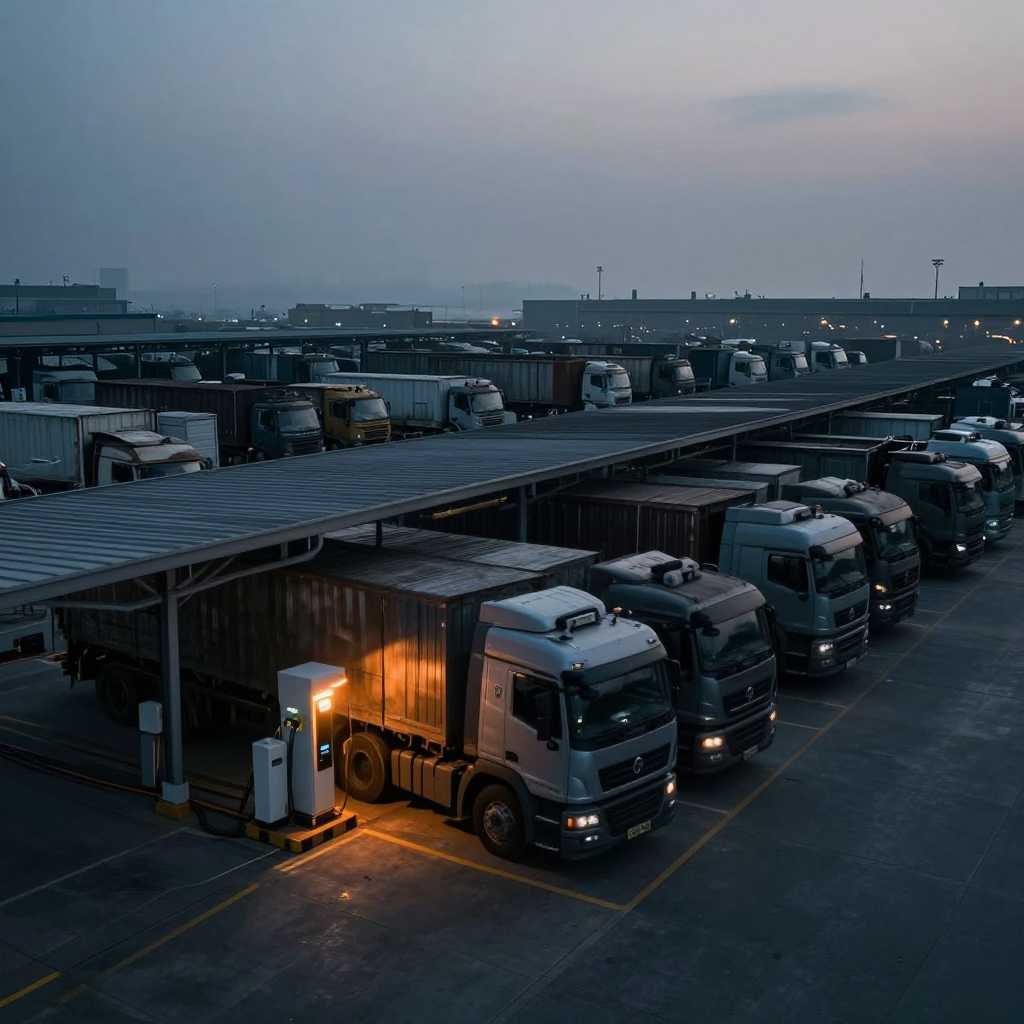
In December 2025, China passed a line the trucking industry had spent years calling a decade away: for the first time, more than half of the new heavy trucks sold in a month were battery-electric — 45,300 of 84,000 units, or 53.9%, up from 36% a month earlier, and 231,100 units for the full year, up 182%. The heaviest, hardest-to-electrify vehicle on the road flipped.
(By heavy truck we mean the diesel workhorses that move most of the economy's goods — the tractor-trailers and large rigid lorries that haul freight between cities and to distribution centres: Class 8 in the US, the EU's N3 category, above 12 tonnes. They are the hardest vehicles to electrify — the biggest batteries, the tightest schedules, and by far the most power to refill — which is exactly why China crossing 50% matters.)
So whether heavy freight goes electric is no longer the question, and Europe's regulators have written the rest of the answer into law: revised EU CO2 standards require new-truck emissions down 45% by 2030 and 90% by 2040. The open question — in Europe, in Asia, everywhere the trucks are now coming — is the charge.
Why the charge is the whole game
A diesel truck's real advantage was never the engine; it was the five-minute fill and a fuel station on every corridor. A truck earns only while it is moving loaded, and freight runs to schedules that don't flex — a supermarket's delivery window, a factory's just-in-time line, a parcel network's overnight sort. Miss the window and the cost isn't a tank of fuel; it's a penalty, a stranded load, a lost customer. So the entire game in electrifying a truck reduces to one question: can it charge inside its duty cycle and keep running, around the clock? Get that right and the rest of the case — far cheaper energy per kilometre, much lower maintenance — falls straight to the bottom line. Get it wrong and none of it counts, because the truck is parked. Keeping the truck on the road is the whole job, and it is a charging job.
| Metric | 2025 |
|---|---|
| New-energy heavy-truck sales (China) | 231,100 units (+182% year-on-year) |
| December 2025, monthly share | 53.9% — electric outsold diesel for the first time |
| EU new-truck CO2 mandate | −45% by 2030, −65% by 2035, −90% by 2040 |
A truck does not charge like a taxi
We built the public charging network for cars: many dispersed points where a driver roams the city and tops up opportunistically, whenever and wherever there's a free plug. That works for a taxi. It is exactly wrong for freight.
A logistics fleet does not roam. It runs defined routes on a schedule — depot out, corridor, delivery, depot back — and it charges at a handful of dedicated, purpose-built hubs sited where those routes actually dwell: the depot, and a few high-power stops along the corridor. You would never blanket a country with truck chargers the way you do taxi chargers; the power per site is too large and the vehicles too few. You build fewer, bigger, planned hubs instead — and they are physically a different animal, too: pull-through bays for an 18-metre articulated rig, megawatt cables, and charging timed to when the fleet returns in waves, not to when a stranger happens by.
That single difference flips the economics. Public passenger charging is a utilisation gamble — will enough strangers show up at this plug? The oft-quoted figure that a swap or fast-charge station needs on the order of 60 uses a day to break even comes from exactly that world, public passenger networks, and it does not transfer to freight. A freight hub sits on a known fleet's scheduled routes: its utilisation is planned, contracted, and high from day one — not hoped for. Freight charging isn't a worse version of public charging; it's a fundamentally better asset, for the same reason a warehouse on a signed lease beats one built on spec.
| Public taxi / passenger EV | Logistics freight fleet | |
|---|---|---|
| Movement | Roams the city, unpredictable | Fixed routes, on a schedule |
| Where it charges | Public network — many dispersed points, opportunistic | A few dedicated hubs — depot + corridor, purpose-built |
| Demand per site | Speculative — a utilisation gamble | Contracted & scheduled — planned high utilisation |
| What it is, as an asset | Merchant, low-utilisation risk | Anchored, investable infrastructure |
One fleet, many trucks — and one of them never sleeps
A real fleet is not one truck. A logistics operator runs a combination to serve its customers — long-haul tractors down the motorway corridors, rigid distribution trucks to the regional depots, smaller vans for the urban last mile, and refrigerated "reefers" for food and medicine — usually from four or five different manufacturers. This is where the manufacturer-led charging networks show both their strength and their limit. Milence, for instance — a joint venture of Daimler Truck, Traton and Volvo — is building excellent high-power hubs along Europe's corridors, but it is, in effect, the truck-makers charging the trucks they sell: the Tesla-Supercharger model, oriented to their own vehicles. A fleet's hub has to serve whatever it actually runs, whoever built it. That vendor-neutral, whole-fleet hub is a different job — the developer's job, not a maker's.
The reefer is the sharpest illustration of why this matters, and of the second thing a freight hub does. A refrigerated truck's cooling unit runs on its own small diesel engine that burns fuel around the clock — even parked overnight — so a reefer consumes roughly a quarter more diesel than a dry truck. Electrify it and two diesel bills vanish at once, the drivetrain and the fridge; independent operators report the cooling energy alone falling 20–40% once it runs on electric standby. But look at what the reefer needs from the hub: power not only to drive, but to sit — holding its load cold overnight while plugged in, instead of idling an engine on the yard. A car charger refuels a car and the car leaves. A freight hub powers the business, around the clock — fast-charging trucks in waves, holding reefers cold on standby, and, as we'll see, trading energy with the grid in between. Same infrastructure, several jobs at once. That is the opposite of a public car charger, and it is why freight charging is infrastructure, not retail.
The bottleneck is the grid — and the hub is a battery
If the hubs are few and planned, the hard part isn't real estate or chargers. It's power. A single megawatt-class truck charger draws what a small town does, and an average European logistics depot needs ten to twenty times its current grid capacity to electrify its fleet — a connection upgrade that takes years, if the grid can offer it at all.
The fix is not a bigger wire. It's on-site battery storage. A hub built with a BESS behind it runs megawatt charging off a modest grid connection: the battery fills steadily when power is cheap, then discharges fast into the trucks. This is already how it's being built — near Paris, a BESS-backed truck charging station pairs a small connection with on-site storage so the fleet never waits on the grid. And here is what turns a cost centre into an asset: that same battery, when the trucks aren't drawing, sells flexibility back to the grid — arbitrage and balancing revenue, exactly as a standalone storage asset does, and especially valuable on the volatile European grid where prices swing hour to hour. The hub earns twice: from the fleet, and from the grid.
| The problem | The hub's answer |
|---|---|
| Depot needs 10–20× its grid power; connections take years | On-site BESS runs megawatt charging off a modest connection |
| A dead charger is a missed delivery | Storage buffers the peak so trucks charge on schedule, around the clock |
| Charging looks like pure cost | The battery sells grid flexibility when trucks aren't drawing — a second revenue |
| Utilisation risk (the public-charging trap) | Anchored to a fleet's scheduled routes — high, planned utilisation |
Two routes to the charge — and both are being built now
There are two ways to get energy into a heavy truck fast, and the market is building both.
Ultra-fast charging is the broad route. The Megawatt Charging System (up to ~1.5 MW, a full charge inside a driver's mandatory 30–45-minute break) is now live: Milence energised Europe's first MCS on the Antwerp–Stockholm corridor and is scaling toward 50 hubs with over €110 million of EU funding behind hundreds of charge points across ten countries; Germany alone has approved €1.6 billion for e-truck charging hubs. It works with any electric truck, off the lot — which is what a mixed fleet needs.
Battery swap is the other route, and it is no footnote. China has proven it at scale for heavy trucks — standardised packs, corridor stations, a five-minute exchange that matches a diesel fill. And it is coming to Europe with serious backing: in June 2026, CATL and Octopus Energy formed a 50-50 joint venture, "Swaptopus," to build heavy-truck swap mega-hubs — first UK sites in 2027, 30-plus across Europe by 2035, aiming to serve 300,000 trucks and unlock £30 billion of investment. Two details matter more than the headline. First, the stations are explicitly designed to double as grid storage, traded into peak prices through Octopus's software — the "hub is a battery" thesis, stated by the people building it. Second, the stations will be owned by the truck-makers and fleets, not the venture — capital pushed onto the asset owners, the very co-ownership structure that makes this investable.
| Ultra-fast charging (nPower's default) | Battery swap | |
|---|---|---|
| The truck | Any standard electric truck — fits a mixed fleet | Must be built to a shared pack standard |
| Refill | Megawatt charge in a 30–45-min break | ~5-minute swap |
| Best fit | Depots + corridors, mixed fleets | Dense, standardised, high-throughput corridors |
| Being built by | Milence (Daimler/Traton/Volvo); BESS-hub developers | CATL × Octopus (“Swaptopus”) |
| The second revenue | On-site BESS trades grid flexibility | The pack rack trades grid flexibility |
The tell across all of it: these networks are being built by truck-makers, energy companies and infrastructure funds — not by the logistics operators. Building and owning fleet-scale power infrastructure is a different business from moving freight, and the operators know it. nPower's default is the vendor-neutral route — ultra-fast charging with on-site storage, which serves any truck in a mixed fleet and delivers the two-revenue economics — with swap deployed selectively where a standardised, high-throughput corridor genuinely earns it. Charging-first, swap where it fits; either way, the asset is the same grid-connected battery.
Where nPower fits
This is exactly the asset our Asia-and-Europe platform is built to own. nPower is an asset developer and investor — not a lender, and not a fleet operator: we fund, build, and own the route-anchored charging hubs freight electrification runs on, engineered around a fleet's actual duty cycle and its actual mix of trucks — depot charging for the return-to-base leg, high-power hubs at the corridor nodes, standby power for the reefers, on-site BESS behind every one to beat the grid and stack a grid-facing revenue, and swap where a standardised corridor justifies it. Because the hub is anchored to contracted fleet demand, it opens at the high, planned utilisation that public networks chase for years — and because it is a battery, it earns from the grid on top. The pitch, three ways:
- The freight operator keeps its capital in trucks and routes and converts without building power infrastructure — energy where and when its trucks need it, for its whole mixed fleet, off its own modest connection, under long-term agreement.
- The co-investor gets an asset-backed energy asset with a contracted floor (fleet throughput) and grid-flexibility upside — the same logic as our European storage platform, not a merchant retail-charging bet.
- The equipment supplier — the makers who lead in fast-charging and storage hardware — co-invests in the assets that deploy its technology, putting cost and capital on the same side.
And the discipline that keeps it investable: we underwrite on utilisation and the energy economics — the fleet's contracted routes and the grid-revenue stack — not on emissions mandates or purchase subsidies. The rules bring the trucks forward; they are never the reason a hub pays.
Why now
China's crossing is the signal; Europe's mandate is the clock. The trucks are coming on a legislated timetable, the grid can't carry them without on-site storage, and the finite inputs are the good hub sites — the depots with power, the substations with headroom, the land at the right corridor nodes. The operators and investors who secure and build them first will own the infrastructure the whole sector has to run on; those who wait will rent it from whoever did.
A taxi needed a network everywhere. A truck needs the right hub, in the right place, built as a battery — one that keeps a mixed fleet moving around the clock and sells power to the grid in between. Build the hub, own the corridor.
nPower develops, finances, and manages EV charging and new-energy infrastructure across Asia and Europe, working with fleet operators, equipment suppliers, and co-investors. If you run a logistics, delivery, or freight fleet and are weighing electrification, we are speaking with operators now about anchor-fleet charging partnerships: contact@npower-ventures.com