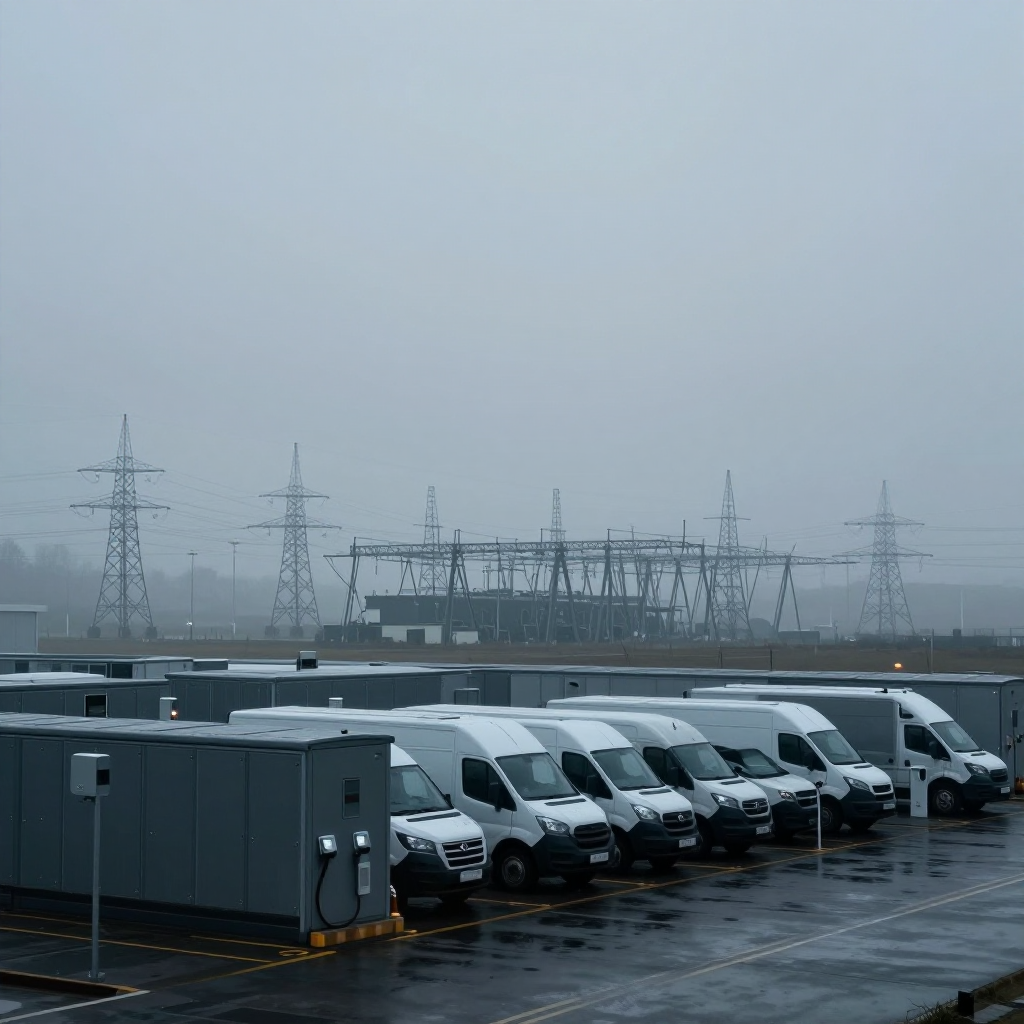
In 2025 the UK ordered its van market to go electric. The Zero-Emission Vehicle mandate required 16% of new vans sold to be electric, on an escalator that climbs to 70% by 2030, backed by fines of up to £18,000 for every non-compliant van. The market managed about 9.6% — barely half the target — even after manufacturers threw roughly £400 million of discounts at the problem. The shortfall is usually blamed on price or range. The real reason is quieter and more damning: across much of Britain, you cannot plug in.
The country is sitting on a grid-connection queue of around 770 gigawatts — roughly four times what a clean-power system needs by 2030, and about ten times the queue of five years ago. Transport operators have been warned they face waits of up to 15 years for the connection a depot full of chargers requires. As the industry body SMMT put it, if an operator has to wait fifteen years to plug in at a depot, there is no case for investment.
You do not have to take a developer's word for how binding this is. Octopus Energy — the UK's largest energy supplier, serving one household in four — has made the same argument the centre of its public case. Its founder, Greg Jackson, contends that with more flexibility “we could largely eliminate these periodic grid issues far more cheaply than relentlessly building infrastructure,” and that the country is “paying millions to turn off clean wind power in the north while firing up fossil plants in the south.” When the biggest company in the market is saying the constraint is the grid — and that the cheaper answer is to use power more cleverly rather than simply build more of it — the shape of the opportunity is not in dispute.
And it is not only a logistics problem. The same wall a fleet hits at the depot is the wall a university hits wiring a new hall of residence, the wall a hotel group hits going all-electric, the wall a student-accommodation developer hits connecting a new block, and the wall any estate hits adding EV charging for staff and visitors. They are all, without realising it, standing in the same queue.
Britain's binding energy constraint is no longer generation. It is the connection.
Opportunity one: keeping electric fleets on the road
For the right duty cycles, the vehicle maths already works. A depot-charged electric van runs at roughly 7–10 pence per mile against 20–25 pence for diesel, and independent fleet data — Epyx's platform, drawing on four million vehicles — shows maintenance about 45% lower by year three. Britain's biggest fleets are moving: Royal Mail runs more than 8,500 electric vans, DPD has electrified about a third of its final-mile fleet, and BT's Openreach placed the largest commercial EV order in UK history. The vehicles are not the problem. Energising them is.
Here is the trap in the obvious answer — “we'll put chargers in our depot.” A depot can charge the vans that come home each night on short, urban, return-to-base routes. It cannot, on its own, keep a fleet running the longer routes: the mileage a truck covers in a day is more energy than a constrained depot connection can put back in the hours it sits still. Charging has to be planned around the route and the fleet, not left to each hub to solve in isolation. The organising principle is the same one that has always governed a diesel fleet: keep the truck on the road.
China has already built exactly this — not depot-only charging, but route networks — at national scale. With around a million electric trucks now on its roads, short-haul drayage already runs on batteries and charges at the depot; the longer routes are served by corridors of megawatt charging and battery swapping. CATL's swap arm ran 305 heavy-truck swap stations at the end of 2025, is heading for 900 in 2026, and is targeting some 80% of the country's trunk-freight capacity by 2030 — with swaps that take about five minutes, matching a diesel fill. Huawei's 100-megawatt corridor parks add 100 km of range in five minutes. Crucially, these networks are planned with the fleets: CATL is building swap capacity for J&T Express's 5,000 trucks; a truck-maker and a logistics group co-deployed 1,000 vehicles along a single 1,250 km corridor.
That model is now crossing to Europe. In June 2026, CATL and Octopus Energy announced a joint venture to build a battery-swap network for electric HGVs across Europe. The question for a British fleet is no longer whether route-based electric logistics works — it plainly does — but who will plan and build the charging around British routes, under agreements that guarantee a fleet its energy where and when its vehicles need it.
Opportunity two: turning a property estate's biggest cost into an asset
The UK's other great electricity load is not the factory floor — Britain has little heavy manufacturing left — but the property estate: hotels, student accommodation, universities, leisure and mixed-use campuses. Their demand is large, steady, and growing, and they sit on the wrong side of two numbers.
The first is price. British commercial and industrial users pay some of the most expensive electricity in the developed world — around 26.6 pence per kilowatt-hour for industry, the highest of 25 countries the IEA tracks, well over twice the EU median. The second is volatility: the number of hours when GB wholesale prices turned negative rose from 29 in 2022 to 149 in 2024 and is forecast to approach 1,000 a year by 2027; on one October day, prices swung almost a hundredfold within hours. And when an estate wants to expand — a new hall, an all-electric refurbishment, a bank of campus chargers — it joins the very same connection queue as the van depot.
The lever these estates have is the same one Octopus has spent a decade proving works: flexibility, behind the meter. Rooftop solar over a hall of residence or a hotel; a battery to shave the expensive peaks and store cheap or on-site power; and, when the asset is otherwise idle, participation in the UK's deep flexibility markets. This is not theoretical. Octopus's Kraken platform already runs what is believed to be the world's largest residential virtual power plant — around 2 gigawatts across more than half a million batteries, EVs and heat pumps — and 1.8 million homes shifted their demand in a single heatwave to relieve the grid, and were paid for it. Kraken optimises roughly half of the UK's grid-scale batteries. The flexibility market is real, liquid, and paying; what most property estates lack is not the opportunity but the asset and the system to capture it.
| Logistics fleet | Property & campus estate | |
|---|---|---|
| The load to power | Vans and trucks, across delivery routes | Halls, hotels, campuses — and their EV charging |
| The wall | Depot & route connections stuck in the queue; grants won't fund the connection | The same queue to add load, at Europe's highest power price |
| Where the opportunity sits | Route-based charging (depot + corridor), planned with the fleet — proven in China | Behind-the-meter solar + storage + flexibility income — proven at scale by UK VPPs |
| The prize | Keep the truck on the road | Turn a rising, volatile cost into a hedge and a revenue line |
What is proven, and what Britain still has to build
Neither opportunity requires an invention. Both require someone to assemble, finance and run what already works elsewhere, around a British fleet's routes or a British estate's load.
| The UK challenge | Where it is already solved |
|---|---|
| Keeping long-haul electric trucks moving | China's 5-minute battery swap + megawatt corridors (305→900 stations); CATL–Octopus JV now bringing swap to Europe |
| Charging planned around routes, not single depots | China's fleet-co-planned corridors (e.g. swap capacity for J&T Express's 5,000 trucks) |
| Behind-the-meter flexibility at national scale | Kraken's ~2 GW residential VPP; 1.8m UK homes paid to shift demand |
| Making high, volatile prices pay | Kraken optimising ~50% of UK grid-scale batteries; deep GB flexibility markets |
Where nPower fits — and what we're still working out
We are an asset developer in energy infrastructure. In Asia we develop commercial EV charging for fleets; in Europe we develop behind-the-meter solar, storage and virtual-power-plant systems for energy users. The UK is a new market for us, and we are still forming our view — but two things already look clear.
First, the opportunity is not at the grid connection, where the whole country is queuing; it is behind the meter and along the route, where a business can act now, on the connection it already has. Second, it is not something bought off a shelf. Charging has to be planned with a fleet around its routes, under agreements that keep its vehicles earning; a property estate's solar-storage-flexibility system has to be designed to its load and actively managed to earn in the markets. The value is in the planning, the capital, and the ongoing management — which is the work we do.
What that looks like in British practice — who funds and owns each asset, how a fleet's routes map to a charging network, how an estate's spare battery capacity is traded when it is idle, and which UK partners we build it with — is exactly what we are working through now. This article is a first marker of where we think the value is. If you run a UK logistics fleet, or a hospitality, student-housing or university estate, and the grid is your bottleneck, we would like to compare notes.
The window
The pressure only builds. The ZEV mandate steps up every year to 2030; Britain's power prices remain Europe's highest; and the connection queue — now being reformed on a “first ready, first needed” basis — rewards those who are ready early. What has changed is that the answers are no longer speculative. Route-based electric freight is running at national scale in China; behind-the-meter flexibility is already grid-material in Britain. The opening is in bringing them together — behind the meter and along the route — for British fleets and estates, while everyone else is still holding a place in the queue.
Britain's problem was never a shortage of ambition, or even of power. It was a shortage of connections. The businesses that stop waiting for the grid, and build behind their own meter, will have solved the one problem everyone else is still queuing for.
nPower is an asset developer in new-energy infrastructure, active across Asia and Europe and now looking closely at the United Kingdom. If you run a UK logistics fleet, or a hospitality, student-accommodation or university estate, and the grid is your bottleneck, we'd like to talk: contact@npower-ventures.com