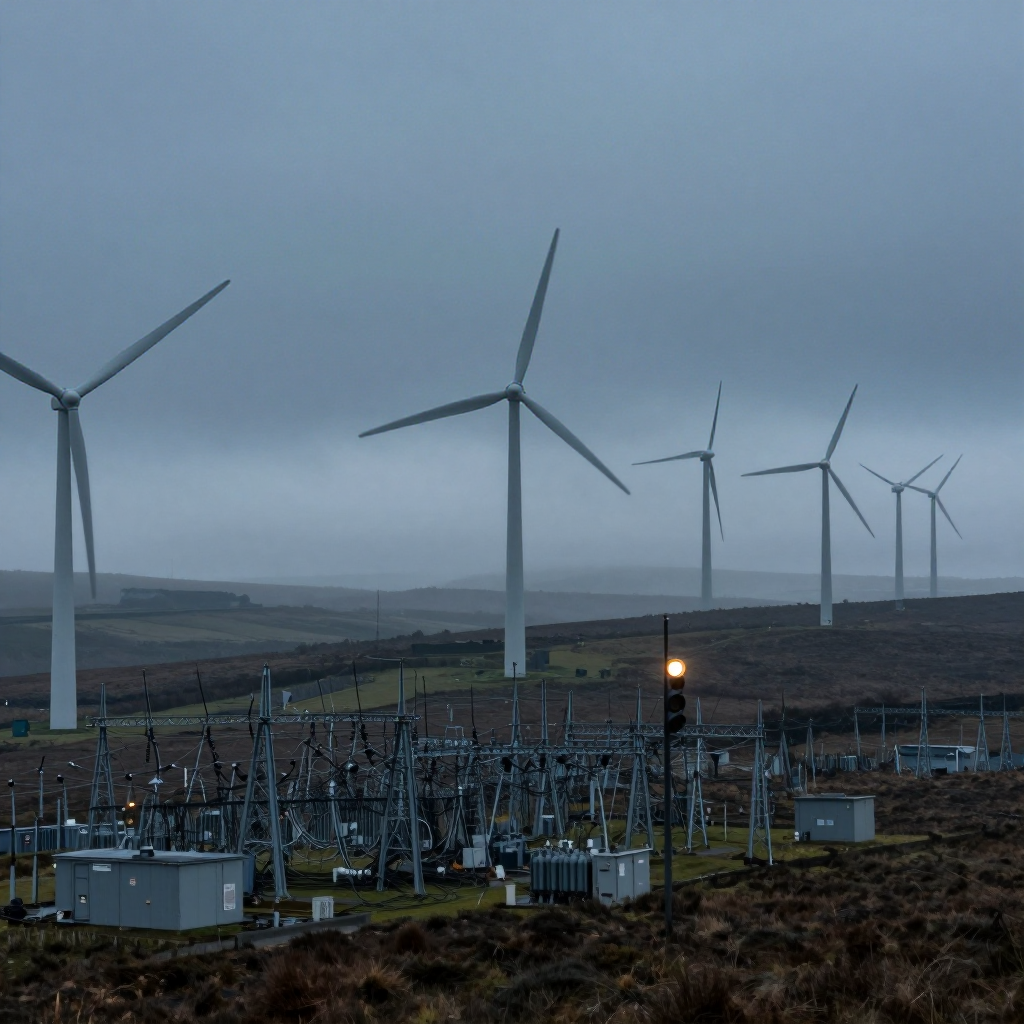
On the windiest days of 2025, some of Britain's newest and cleanest power stations were told to stop. Not because the wind dropped — because the grid could not carry what they made to where it was needed. Managing those constraints cost around £1.7 billion in 2024/25 — the single biggest driver of a £2.7 billion balancing bill — as the system paid wind farms to switch off and gas plants to fire up in their place, and spread the cost across every bill in the land. On its own projection, the system operator (NESO) warns that bill could spike toward £8 billion a year by 2030 unless a set of major grid upgrades is accelerated; on the way there, it expects Britain to be curtailing roughly 22 terawatt-hours of wind and solar a year — clean power simply thrown away, with far more exported at a loss.
It is tempting to read this as a British failure, or to go looking for the country that "solved it" so Britain can copy the homework. That is the wrong move, because no two grids waste power for quite the same reason, and the one country that most completely conquered the problem — China — did it with a machine Britain cannot build. The more useful approach is the one any investor applies to a mispriced asset: go back to first principles. What, exactly, is the problem? What are the options? And which option actually works and can be built by a private developer in a market economy?
The problem, stripped down
Underneath the jargon of "constraints" and "curtailment," the problem is simple. Britain now generates a great deal of its cheapest power — wind — in the north, above all in Scotland, and consumes most of it in the south. The wires between them, at a set of boundaries the system operator calls B6, are too narrow to carry the surplus. When the wind blows harder than the wires can take, the system operator pays Scottish wind farms to stop, and pays southern gas plants to fill the gap. The consumer pays twice: once to waste the clean power, once to burn the expensive substitute.
That is a mismatch in place and time: the power exists, but not where and not when it is wanted, and there is no way to bridge the gap fast enough. Everything else — the £1.7 billion, the negative prices (Britain saw wholesale power priced below zero roughly six times more often in 2024 than in 2022), the rising surcharge on every bill — is a symptom of that single mismatch. Solve the mismatch and the symptoms go with it.
There are, at the level of first principles, only four ways to close a place-and-time gap between supply and demand. Britain is attempting, or has abandoned, every one of them.
The four options
Option 1 — Move the power in space: build the grid. More and bigger wires, to carry the northern surplus south. This is the route China took, at continental scale, with its ultra-high-voltage network. Britain's version is the "Great Grid Upgrade," costed by the system operator at up to £89 billion and arriving over roughly a decade. It is necessary, and it is happening. But it is slow, enormously capital-hungry, and — the point that matters — a market democracy cannot command land, capital and planning consent the way a state-directed system can. New transmission will help Britain in 2035. It does nothing for the £1.7 billion being wasted now.
Option 2 — Redesign the market so price reflects place: zonal pricing. Split Britain into price zones so power is cheap where it is abundant, giving generators and users a reason to locate and consume where the wind actually blows. It was the reform Octopus Energy — the country's largest supplier — argued hardest for; its founder, Greg Jackson, has said flexibility could "largely eliminate these periodic grid issues far more cheaply than relentlessly building infrastructure." It was opposed by much of the generation industry, including SSE and RenewableUK, who warned it would raise the cost of capital for new renewables. In July 2025 the Government scrapped it, opting for an undefined "Reformed National Pricing." We take no side in that fight. The relevant fact is neutral: this option is off the table for years. (Octopus and Greg Jackson are referenced here as the most prominent public voices in that debate; nPower has no relationship with them.)
Option 3 — Move the demand to the power: interconnectors and demand flexibility. Export the surplus abroad through subsea cables, or shift flexible loads — including EV charging — into the windy, cheap hours. Both help at the margin. But interconnectors are as likely to import price volatility as to relieve it, and demand you can move is a fraction of demand overall. This trims the problem; it does not close it.
Option 4 — Move the power in time: store it. Charge a battery when power is surplus — including the hours when prices are at or below zero, being paid to absorb what the grid cannot use — and discharge it into the evening peak. Storage is modular, quick to deploy, needs no one's permission, and works under any market design — national or zonal, reform or no reform. And it is increasingly placed behind the meter, at the site that uses the power, rather than waiting in the transmission queue.
| Option | What it does | Status in Britain | Who can do it |
|---|---|---|---|
| Build the grid | Moves power in space | ~£89bn, ~a decade away; needs state-scale planning | Government / networks |
| Redesign the market (zonal pricing) | Prices power by place | Scrapped, July 2025 | Government |
| Move the demand | Exports or time-shifts load | Helps at the margin; bounded | Mixed |
| Store the power | Moves power in time | Deployable now; needs no permission; regime-agnostic | The private market |
The evidence that storage works
This is not a theory. The market economies that hit this wall before Britain did not wait for a perfect grid or a perfect market — they built storage, and it worked. These are references for the proposal, not templates Britain must copy.
Australia is the clearest case, and the one closest to nPower's model. South Australia runs on about 74% wind and solar — it met 100% of its own demand from renewables on roughly 99 days of 2024 — and at midday it routinely dumps that surplus into negative prices. It did not, and could not, build a China-style national grid. Instead the market built storage: the Tesla "big battery" at Hornsdale captured more than half of the state's frequency-services market within six months and saved consumers over A$150 million in two years, earning precisely by charging during the negative-price hours. On top of it, hundreds of thousands of household solar-and-battery systems were stitched into virtual power plants — distributed, behind-the-meter, aggregated into one dispatchable resource. That is nPower's model, proven at grid scale in a market democracy.
California answered its "duck curve" — 3.4 million megawatt-hours of solar curtailed in 2024 — by building a battery fleet that has grown to roughly 13 gigawatts, now shifting midday solar into the evening and displacing gas. Texas, with no mandate at all and a pure price signal, went from 0.2 to about 14 gigawatts of batteries in five years, the largest fleet in the United States. Different grids, different flavours of waste — the same cure.
And China — the country that beat the worst curtailment on Earth — is best understood here not as the problem-mirror but as the solution. It cured its own wastage largely with a grid Britain cannot replicate, but its lasting legacy is the world's largest storage industry and, for anyone building storage anywhere, the cheapest hardware on the planet: battery packs in China run around $84 per kilowatt-hour, roughly 40–55% below US and European prices. The tools that make Option 4 investable are, overwhelmingly, Chinese.
| Market | The waste | The answer they chose | Result |
|---|---|---|---|
| South Australia | Midday solar/wind surplus → negative prices | Grid battery (Hornsdale) + household VPPs | ~74% renewable; battery saved consumers >A$150m in 2 yrs |
| California | 3.4m MWh curtailed in 2024 (93% solar) | ~13 GW of batteries | Curtailment share falling; evening gas displaced |
| Texas | Midday oversupply, extreme volatility | ~14 GW merchant batteries (no mandate) | Largest US battery fleet, built on price signal alone |
| China | Worst curtailment on Earth (~17% wind, 2016) | State grid + the world's largest storage build | Cured; now the cheapest battery supply chain, by far |
There is one instructive exception. Norway is nearly 100% renewable and barely wastes a drop — because its power is hydro behind dams, and a reservoir is a giant natural battery: when there is a surplus, Norway simply holds the water. It got its storage for free, from geology. Britain's wind gave it no such gift. The lesson is not that Britain is unlucky; it is that storage is the thing that turns intermittent clean power into usable clean power — and where nature does not provide it, someone has to build it.
The option that fits nPower — and the co-investor's logic
First principles selects Option 4, and Option 4 is, precisely, what nPower does: behind-the-meter solar, batteries and the software to run them for the businesses that carry a heavy electricity load. We are an asset developer in energy infrastructure — not a lender, a fund, or an energy retailer. We fund, build, and own — or co-own with the host — a system engineered to the site's load, run first for the site's own stability and cost and then, with whatever capacity is genuinely spare, for the markets, capturing the surplus and volatility the rest of the system is paying to waste. The revenue it earns is shared with the host.
| Exposed (do nothing) | Behind the meter (with nPower) | |
|---|---|---|
| Constraint & balancing costs | Socialised onto your bill, on a path toward £4–8bn/yr nationally | Hedged — on-site solar + storage cut your exposure |
| Cheap and negative-price hours | Someone else's opportunity | Charged into a battery, discharged at the peak |
| Expanding your connection | Years in the transmission queue | Worked around behind your own meter |
| The "second revenue stream" | Forgone, or needs an in-house trading desk | Captured by an AI-driven virtual power plant, shared with the host |
| Capital & ownership | On your balance sheet | nPower funds and builds; co-investors and hosts can co-own |
For a co-investor — including the foreign capital that knows this sector best — the logic is unusually clean. The problem is real and sized: Britain is going to spend the second half of this decade paying, through everyone's bills, for power it cannot move. The answer is proven, in market economies, not just in theory. The market is hard-currency and rule-of-law. The hardware is the cheapest in the world, and its supply chain is one many of our co-investors know intimately. And the reason the private route wins is the very thing that makes Britain unlike China: because the country cannot out-build its geography by decree, the value migrates to whoever will store and time the power behind the meter. nPower is the developer that assembles the capital, the equipment and the British sites into that asset — and co-investors and equipment suppliers can own it alongside us.
The United Kingdom is a new market for us, and we are still forming our view of exactly how and with whom we build here. But the shape of the opportunity is not in doubt.
The window
Every input is moving the same way. The renewable build-out guarantees more surplus and more waste, not less. The grid fix is a decade and £89 billion away. The market-design fix has just been shelved. Battery costs are at record lows. Each of those, alone, argues for storage behind the meter today; together they are close to a consensus.
Britain spent years building the machine that generates cheap, clean power, and is now discovering that generating it was never the hard part — moving it and timing it is. It cannot solve that the way China did, and it has just declined to solve it the way the market reformers wanted. What is left is the option that never needed permission: store the power, behind the meter, where it is used. The country is currently paying, at a scale rising toward billions a year, to prove how much that capability is worth. The only question for an energy-intensive business, or an investor watching this market, is whether they will own the asset — or keep paying the bill for not having it.
nPower develops, finances, and manages new-energy infrastructure across Europe and Asia — behind-the-meter solar, storage and virtual-power-plant systems for industrial and commercial sites — working with energy users, equipment suppliers, and co-investors, and now looking closely at the United Kingdom. If your business carries a heavy power load, or you invest in the assets that carry it, we'd like to talk: contact@npower-ventures.com