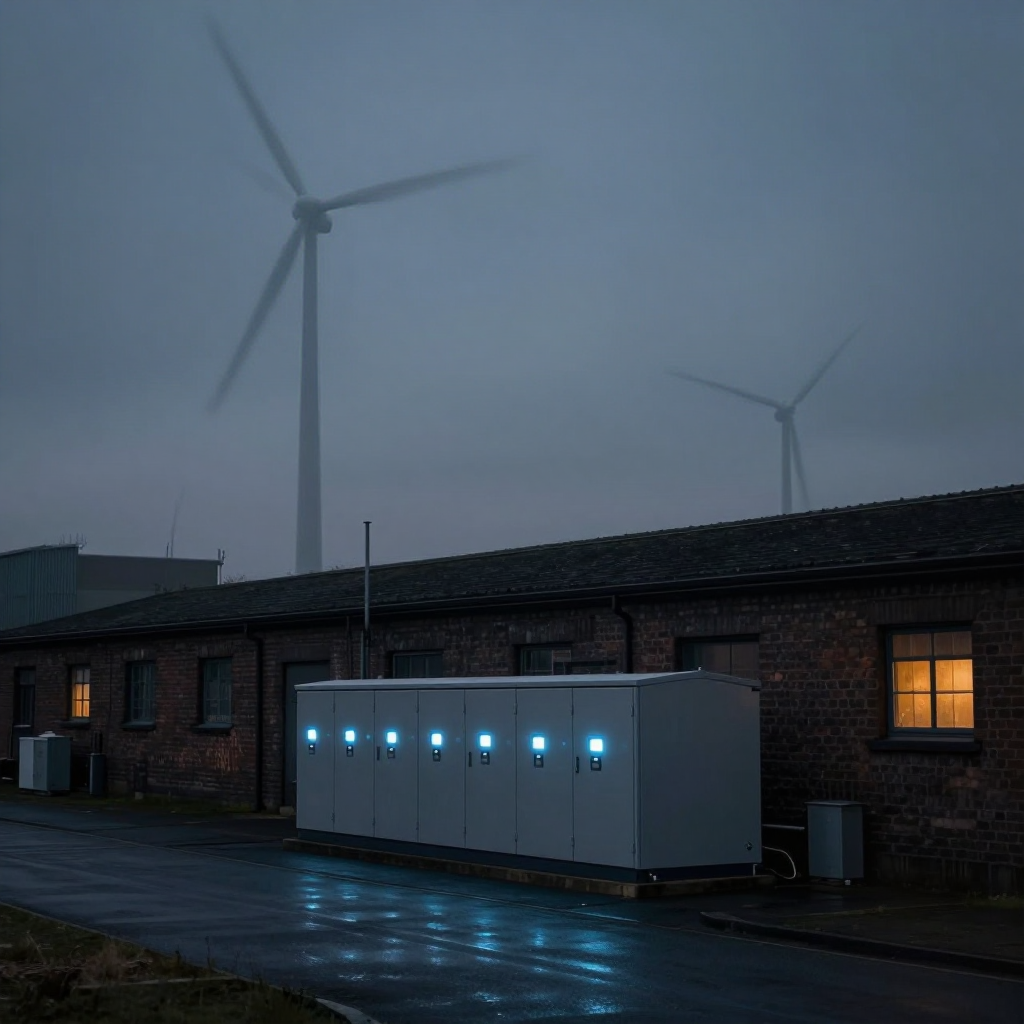
Britain has a strange kind of energy problem. On its windiest days it builds more clean power than it can use — and pays wind farms to switch off, while firing up gas plants to fill the gap somewhere else. Managing those constraints cost the system around £1.7 billion in 2024/25, on its way, the system operator warns, toward £8 billion a year by 2030. At the very same time, British businesses pay some of the highest and most volatile electricity prices in the developed world. A country awash in clean power it throws away; customers paying a fortune for it. Britain is addressing part of this the hard way — more wires, more wind, both needed and both slow. But the ingredient missing underneath both symptoms, and the one a business can actually own, is flexibility: the ability to move power in time, from the moment it's abundant and cheap to the moment it's scarce and dear.
Germany offers the clearest proof of how fast the demand for this can move: once it made distributed energy frictionless, households plugged in more than a million balcony solar systems in a couple of years. But the balcony boom is a spark, not the fire. The panel was never the point. The point — for a business that wants control over its energy — is what you do with power once you have access to it: when you store it, when you use it, when you sell it back. And that is a storage-and-software problem, not a rooftop one.
The missing piece is flexibility — and a business can own it
Look closely at Britain's billions of curtailment cost and you see the opportunity inverted. The grid wastes clean power because it cannot time or move the surplus. A battery behind a business's meter does exactly what the grid can't: it charges when power is cheap — sometimes when it is priced below zero — and discharges into the expensive evening peak. Layer software over it — a virtual power plant (VPP) that aggregates many such batteries and dispatches them into the market — and the same asset earns a second income selling that flexibility back to the grid that so badly needs it. The national inefficiency and the private opportunity aren't the same electrons — a battery in a Bristol hotel doesn't literally soak up a curtailed Scottish wind farm — but they run on the same logic: value is leaking out of the system for want of flexibility, and a business that supplies its own can capture a share of it.
| The symptom | What it really is |
|---|---|
| ~£1.7bn paid in 2024/25 to curtail wind & fire gas (→ ~£8bn by 2030) | Clean power the grid can't move or time — a flexibility gap, not a shortage |
| Wholesale power priced below zero far more often than a few years ago | Hours a battery is paid to charge |
| Businesses paying volatile, world-high tariffs | The spread a stored kilowatt-hour captures at the evening peak |
Energy security has landed on the SME's balance sheet
For decades, energy security was a national, wholesale worry. It now sits squarely on the profit-and-loss of the individual business. Britain is not a resource-rich nation: North Sea output is in structural decline and the country imports a rising share of the gas that still sets its power price at the margin — so a war in Ukraine or a crisis in the Gulf resets a British hotel's or workshop's energy bill overnight, through no fault of its own. Non-domestic electricity has run at around four times US levels (IEA), and can spike without warning. For a hotel spending six figures a year on power, or a student-accommodation operator on a fixed rent roll, that volatility is not a line item — it is the risk most likely to sink an otherwise healthy business.
Here the China comparison is instructive, but not in the way people assume. China did not achieve energy security because it was rich in oil and gas — it isn't. It built its security: the storage, the manufacturing, the flexibility. Britain, equally resource-poor, faces the same logic and cannot import its way out. What it can do — and the only lever an individual business actually controls — is build security behind its own meter. That is the private-sector, market-led version of what China did with the state: take control of when and how you consume, so the next global shock is someone else's problem.
The technology is ready — and the value is local
None of this is waiting on a breakthrough. The hardware is abundant and cheap: Chinese solar modules sell at around $0.09 per watt, battery packs are near record lows of $70–90 per kilowatt-hour, and VPP-ready inverters and controllers are off-the-shelf. But — and this is the part that matters for Britain — the cheap imported hardware is the smallest part of the value. In a typical UK commercial installation costing £0.75–£1.05 per watt, the module is only around a tenth of the price; the other ~90% is the engineering, the battery, the controls, the software and the labour, delivered locally. A cheap Chinese panel doesn't hollow out British value — it seeds it: it is the input that lets a UK integrator build a system, employ engineers, and hand a business years of lower, steadier bills.
| Stage | Roughly | Where the value lands |
|---|---|---|
| Imported hardware — module | ~$0.09 / W (a 450 W panel ≈ $40) | Commodity, from China |
| Installed system — EPC, battery, inverter, controls, labour | £0.75–£1.05 / W (module ≈ 10%) | ~90% local: engineering & jobs |
| Over its life — a lower, steadier bill + flexibility income | years of savings for the business | The SMB host |
How storage and VPP turn power into flexibility
Solar alone just shaves a daytime bill. Storage plus software is what creates flexibility — and flexibility is what pays. Concretely, for a hotel, a student block or an SMB, a behind-the-meter battery run by a VPP does four things at once: it shifts self-generated or cheap off-peak power into the expensive evening peak; it avoids the punishing peak-time and capacity charges that load a commercial bill; it arbitrages the widening gap between cheap and dear hours; and, aggregated with hundreds of other sites, it sells flexibility into the grid's balancing and reserve markets — access to which is opening up to exactly these small, distributed assets. One machine, four revenue and savings streams, all of them growing as the grid gets more volatile — which, on every forecast, it will.
| What it does | How the business gains |
|---|---|
| Shift | Moves cheap off-peak or self-generated power into the costly evening peak |
| Avoid | Dodges the peak-time and capacity charges that load a commercial bill |
| Arbitrage | Captures the widening gap between the cheapest and dearest hours |
| Sell flexibility | Aggregated by the VPP, earns from the grid's balancing & reserve markets |
What the prize looks like, at market rates
None of this is theoretical, and the numbers are not ours to invent — they sit in the public record. UK industrial power runs near 26p per kilowatt-hour, among the developed world's highest, so every unit a site generates and uses on-site displaces its most expensive input. Independent installers put the payback on a commercial solar-plus-storage system at roughly three to eight years, depending on how much of its own power the site consumes. And the flexibility layer is now a market in its own right: batteries in Great Britain have been earning on the order of £70,000 per megawatt a year, with behind-the-meter access widening as the market rules change. These are third-party, market-level figures — not an nPower projection — but they are why, for an energy-hungry business, the meter is where the money now is.
| What | Roughly | Source |
|---|---|---|
| UK industrial electricity | ~26p / kWh — about 4× US, and the highest of the 28 IEA economies | IEA (2025) |
| Commercial solar + storage payback | ~3–8 years, depending on on-site use | UK installer surveys |
| Battery flexibility revenue (GB) | ~£70,000 / MW / year, and access widening | Modo Energy (2025) |
Where nPower comes in — the enabler
This is precisely the role nPower is built for: the enabler that takes an SMB the whole way from problem to owned asset. We are an asset developer and investor — not a lender, and not a kit seller — and we do three things for our target segments (hospitality, student accommodation, and other SMBs):
- Source. Direct relationships with the Chinese manufacturers who lead the world on cost and technology — often as co-investors in the assets their equipment goes into. The edge here isn't a margin on the panel — that's a commodity anyone can buy; it's suppliers putting capital alongside ours, and our assets getting priority access to the latest kit.
- Solution. We design, permit and build the behind-the-meter system — solar where it helps, storage and the VPP always — engineered around how the business actually uses power.
- Invest. We fund and own it, or co-own it with the host, and run the optimisation. The business gets flexibility, lower and steadier bills, and resilience with no capital of its own and none of the complexity; nPower and its co-investors get an asset with a contracted floor and market upside, aggregated across many sites into a portfolio.
This is also the line between us and a plain rooftop-solar PPA. A PPA sells a business a discount on its own roof and keeps the upside; we build and run the whole storage-and-flexibility asset, and leave the host a share of that upside through co-ownership — not a signed-away long-term contract.
And the discipline that keeps it investable: we underwrite on market economics — prices, tariffs, volatility — not on subsidies. The flexibility is worth money because the grid is short of it, not because a policy says so.
Why now
Every input points the same way, at once. Energy security has moved from headline to invoice, with the Ukraine and Gulf shocks fresh and the North Sea in decline. Battery costs are at record lows and Chinese supply is abundant. The grid's flexibility gap — those billions paid to waste wind — is widening, and the markets that pay for behind-the-meter flexibility are opening to small, aggregated assets for the first time. Britain cannot out-produce or out-import its way to energy security. It can out-flex it. For the country's SMBs, the meter is the frontier — and nPower is the enabler that gets them there.
nPower develops, finances, and manages new-energy infrastructure across Europe and Asia — behind-the-meter solar, storage and virtual-power-plant systems for industrial and commercial sites — working with energy users, equipment suppliers, and co-investors. If your business carries a heavy power load, or you invest in the assets that carry it, we'd like to talk: contact@npower-ventures.com