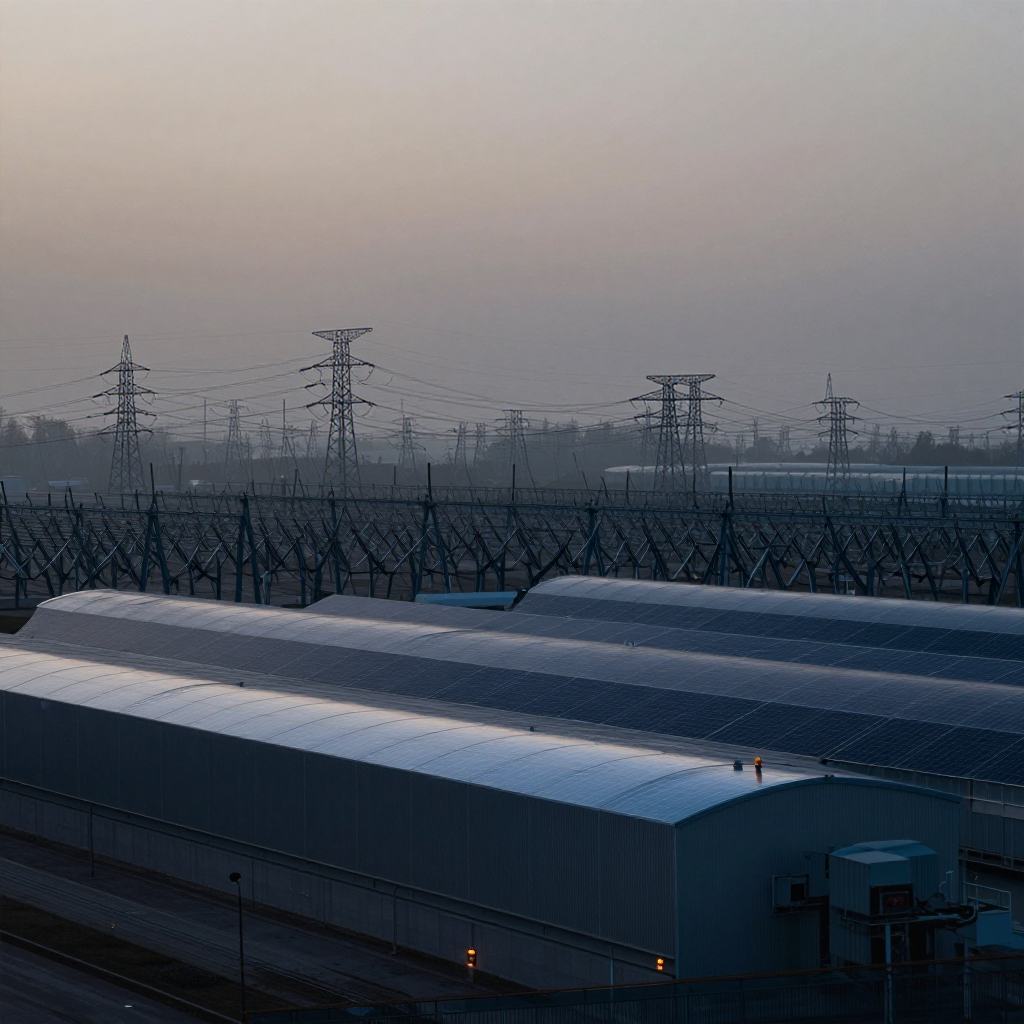
In mid-2025 one of the world's largest steelmakers did something that should have stopped every European industrial owner cold. ArcelorMittal cancelled the plan to convert two German plants to low-carbon steel and, in doing so, handed back roughly €1.3 billion of committed government subsidy — money already on the table. Not because it had gone cold on the technology, but because even with the subsidy, the electricity price the finished plant would run on made the economics impossible. When a business turns down a billion euros of free money because the power price still doesn't work, the subsidy was never the answer — and neither is waiting.
That decision is the whole European problem in one move. Mario Draghi had already put the number on it: EU firms pay 2 to 3 times more for electricity than US firms, and energy-intensive output has fallen 10–15% since 2021. A year on, the IEA's 2026 review confirms the gap held — through 2025, industrial power in Europe ran at roughly double US levels. This is not a spike waiting to fade. It is the standing price of running a plant in Europe.
The giants have an exit: move the next line to Texas or Guangdong, and many are. You probably can't. A mid-market industrial park, a regional factory, a food or logistics operation is rooted where it is — its customers, its workforce, its site. So the 2× bill is not a temporary headwind you wait out; it is a permanent tax on staying still. The good news is the part nobody tells you: you are already sitting on the three scarcest assets in European energy — you just haven't been paid for them yet.
Why the gap is permanent — and why the exits are closing
Europe's wholesale price is usually set at the margin by imported gas, so even a grid full of cheap wind and solar clears at the price of the last, dearest generator. Add grid charges, levies and the carbon price, and a high-tariff European site routinely pays north of €0.20 per kilowatt-hour. Fixing that at the system level — interconnection, market reform, a faster grid — is real, necessary, and a decade away. It runs on twenty-seven governments and tens of billions in transmission. Your profit-and-loss cannot wait for it, and — as the €1.3 billion showed — no subsidy makes a broken power price whole.
The casualty list is already being written across the heavy-industrial base Europe, unlike Britain, still runs at scale:
| Sector | What happened | Where |
|---|---|---|
| Steel | ArcelorMittal cancelled two green-steel conversions and gave up ~€1.3bn of subsidy, citing energy costs; EU steelmakers have trimmed output as bills climbed | Germany |
| Chemicals | BASF has cut thousands of European jobs and closed lines since 2023, and directed its largest new integrated investment abroad, to China | Germany |
| Aluminium | Speira shut its Rheinwerk primary-aluminium smelter; European primary-metal output runs far below pre-crisis levels | Germany |
Read that table as the host, not the analyst. Every one of those firms is superbly run — and each concluded that at 2× a rival's power price, the European tonne stops making sense, so the next investment goes elsewhere. That is the option a mid-market operator doesn't have. Which means the question isn't "will power get cheaper?" It's "what do I own, on my own site, that changes my exposure?"
What you already own — and what it's worth
Three things make an energy asset possible, and all three are scarce. You have them:
- A grid connection. Across much of Europe a new or upgraded connection is a multi-year queue. Yours already exists. In a world of queues, an in-place industrial connection is not plumbing — it is an appreciating asset.
- A site. Roof, yard, car park, land — the physical space solar and storage need, sitting idle above a business that pays top-of-market for power.
- Anchor demand. Steady, contracted on-site load. It is exactly what makes an energy asset bankable and lets it run at high utilisation from day one, instead of chasing customers for years.
You have been treating all three as overhead. They are the raw material of an income-producing asset — you simply haven't been paid for them.
The transformation: your dearest cost becomes an asset you own
The move is to stop buying power and start making and storing it, behind your own meter. The economics are no longer aspirational — they are simply cheaper. On-site solar produces power at around €0.05 per kilowatt-hour, roughly a quarter of the grid tariff; and the piece that used to break the case, storage, has collapsed — BloombergNEF's end-2025 survey put stationary battery packs at about $70/kWh, down ~45% in a year, now the cheapest battery segment of all. Solar covers the day, the battery shifts the surplus into the expensive evening, and software trades whatever is spare into the flexibility markets.
| Cost of a kilowatt-hour | Approx. level |
|---|---|
| Grid — industrial tariff, high-tariff EU market | > €0.20 / kWh |
| On-site solar — levelised cost | ~ €0.05 / kWh |
| Stationary battery pack (end-2025) | ~ $70 / kWh — down ~45% in a year |
The market is already moving this way — Europe installed a record 27 GWh of battery storage in 2025, up ~45%, with the industrial-and-commercial segment its fastest-growing part, and solar increasingly financed only with storage attached. The direction is set. The only question is whether you own the asset on your site or watch the value accrue to someone else's.
Why you don't do it alone — and why it isn't a PPA
If it's this clear, why hasn't every factory covered its roof? Because a serious behind-the-meter system is a six- or seven-figure project competing with your core-business capital; it needs permits, connection work and compliance; and capturing the full value — self-consumption plus stored arbitrage plus flexibility income — takes a trading-and-optimisation layer no manufacturer runs in-house. The opportunity is obvious; the execution is exactly what you are not built to do.
This is where nPower comes in — and where the offer differs from the rooftop deal you've been pitched before. A PPA sells you a discount on your own roof and keeps the upside. We don't. We fund, build and own the solar-storage-VPP asset — or co-own it with you — engineered to how your site actually uses power. You put in no capital; we carry the grid, permits and compliance; you get a hedged, lower bill and a co-owner's share of what the asset earns trading its spare capacity. You contribute the connection, the site and the demand; we contribute the money, the build and the software; and you end up owning a piece of the asset instead of signing your roof away.
| Keep buying power (or sign a PPA) | Own it with nPower | |
|---|---|---|
| Your energy cost | ~2× US, gas-set, compounding forever | a large share self-supplied well below the grid tariff |
| Your connection, roof & demand | overhead you pay to run | your stake in the asset — the scarce inputs you contribute |
| Capital & delivery | yours, or the PPA developer's | nPower funds, builds & carries grid/permits |
| The upside from flexibility | forgone, or kept by the PPA seller | shared with you as co-owner |
That we can build it is not in doubt: the capital and the equipment supply are already lined up behind assets like these — the constraint the whole market is short of is exactly what you hold, a site with a live connection and real demand. And the discipline that makes it investable is the lesson of that €1.3 billion: we underwrite on the market spread, not on subsidies. The 2× gap is not a policy that might lapse — it is the structural price of European power, and an asset that works because of it is infrastructure, not exposure.
Why now
Draghi turned expensive energy from a grumble into the named threat, and the year since confirmed the number. Battery costs are at record lows, on-site solar is a quarter of the grid tariff, and every quarter of delay is another quarter of paying twice a competitor. The best sites — the ones with roof, yard, load and a live connection — are finite, and the operators who move first will own assets that only look better as the grid stays dear.
Europe spent three years hoping its power problem was temporary. A steelmaker's €1.3 billion says it isn't. You can't relocate your way out of it — but you can own your way out. The question is whether the connection, the roof and the demand you already have stay a cost on your books, or become an asset on them.
nPower develops, finances, and manages new-energy infrastructure across Europe and Asia — behind-the-meter solar, storage and virtual-power-plant systems for industrial parks, SMBs and commercial energy users — funded alongside co-investors and equipment suppliers, and co-owned with the hosts whose sites they sit on. If you run an industrial site carrying a heavy power load, we'd like to talk about owning it together: contact@npower-ventures.com