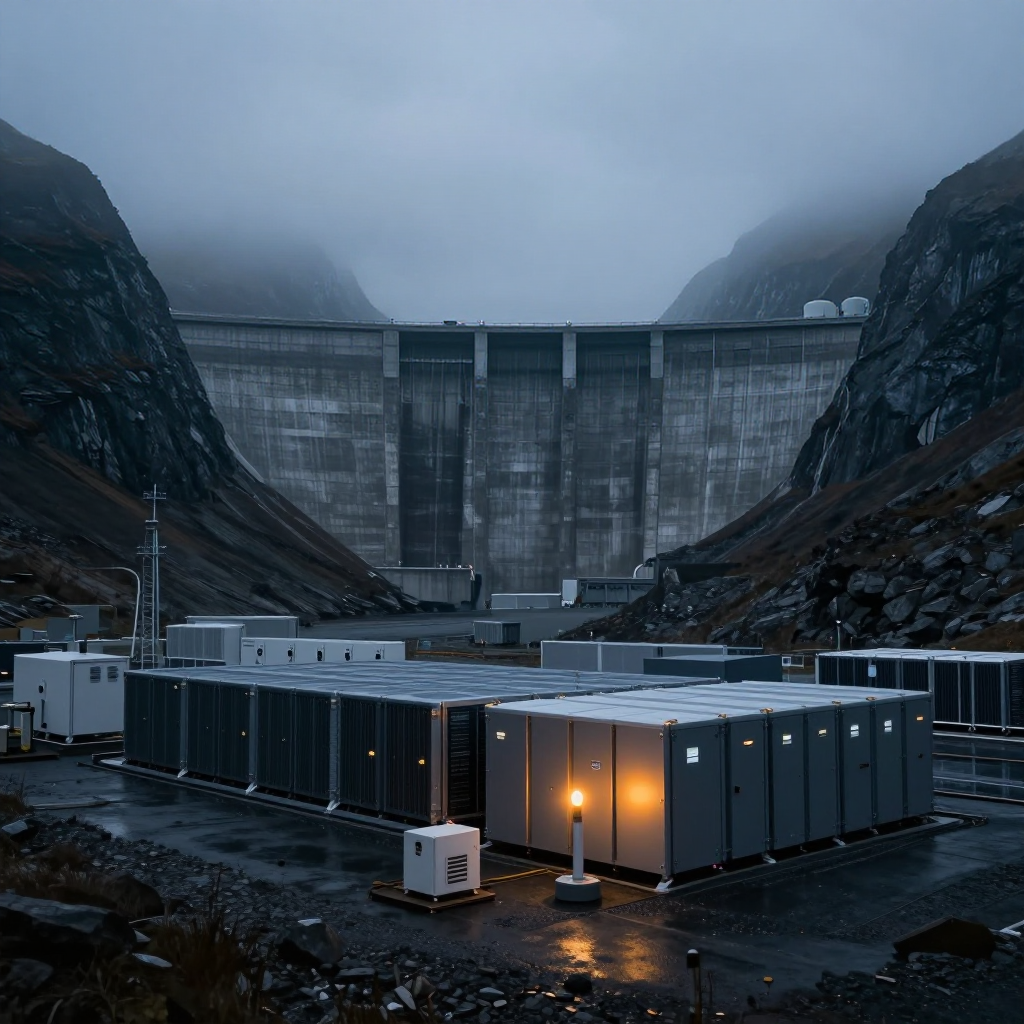
Norway should be the calmest electricity market in Europe. Ninety per cent of its power is hydro — clean, dispatchable, and historically among the cheapest on the continent. So it says something about where Europe's grid is heading that, in a single hour in mid-December 2024, the wholesale price in southern Norway hit NOK 13.16 per kilowatt-hour — around €1.12 — the highest since 2009 and roughly twenty times the level of the week before. At the same moment, in the north of the same country, power was trading near NOK 0.12. Across one nation, on one grid, prices differed by more than a factor of ten.
The politics followed the price. Six weeks later, in January 2025, the Centre Party walked out of Norway's governing coalition over the country's adoption of the EU's energy rules, collapsing the government. The dispute was, at its heart, about the interconnector cables that now tie Norway's hydro to Germany and Britain — and that transmit their price volatility straight into Oslo living rooms. Norway's answer for households was a fixed-price shield, "Norgespris," capping domestic power at 40 øre per kilowatt-hour. More than 1.6 million households have signed up. But the shield is for households. Factories, workshops, data centres, cold stores — the businesses that actually run on that power — remain fully exposed to the swings. And DNV now projects Norwegian electricity demand growing roughly six times faster than new supply, tipping the country toward a power deficit around 2030.
If volatility has come for the hydro superpower, it has come for everyone.
The engine: why the swings are structural, not a phase
This is not a bad-weather story that passes. It is the mechanical consequence of how a renewables-heavy grid behaves, and it intensifies as more solar and wind come online.
The pattern is clearest in Germany. In 2025 the German day-ahead market recorded 573 hours of negative wholesale prices — moments when there is so much power on the grid that producers pay to offload it — up from 457 hours in 2024. The average gap between the cheapest and dearest hours of the day widened to around €130 per megawatt-hour, more than four times the roughly €30 spread of 2019. The cause is the "duck curve": more than 100 gigawatts of German solar now floods the middle of the day, collapsing midday prices, while the evening ramp — when the sun sets but demand does not — sends them spiking. The value of a German solar panel's output, measured against the average market price, has fallen from near 98% in 2022 to about 54% in 2025. The panels still generate; they just generate when everyone else does, into a price near zero.
The Netherlands shows the same physics with a sharper edge. Dutch negative-price hours in the first ten months of 2025 already exceeded the whole of 2024. Across the Nordics, Sweden's SE2 zone logged the most negative hours of any market in Europe. This is now a continent-wide condition.
The paradox: abundance and scarcity at the same time
Here is the counterintuitive part. Europe does not have too little power or too much. It has both — at different hours, in different places — and no way to move it between them fast enough.
That "no way to move it" is the second half of the story, and the Netherlands is its extreme. Dutch grid operator TenneT is sitting on a connection queue of about 38 gigawatts of requested capacity — against a national peak demand of only around 19 gigawatts. The waiting list to plug in is nearly twice the entire country's power draw. More than 12,000 businesses are queued for a new or larger connection; some face waits of up to ten years; nine in ten Dutch companies report grid congestion already affecting them. Across Europe, more than 1.7 terawatts of projects sit stuck in connection queues, and in 2023 alone the EU curtailed over 12 terawatt-hours of renewable output — power generated and thrown away — at a congestion-management cost of €4.2 billion.
So the grid is simultaneously drowning in cheap midday power it cannot absorb and starved at the evening peak it cannot serve. In that world, the scarce, valuable thing is no longer another megawatt of generation. It is the ability to move a megawatt — from the sunny noon when it is worthless to the dark evening when it is precious, or from the congested feeder to the one with headroom. That capability has a name: flexibility. And flexibility, unlike generation, gets more valuable exactly as the volatility that everyone else fears gets worse.
Volatility is not the risk in this market. Volatility is the product.
And the direction of travel is genuinely unknown. Demand is climbing on two fronts at once — the electrification of transport, heat and industry now under way across Europe and Asia, and the sudden, vast appetite of AI data centres, whose Nordic power demand is projected to roughly triple by 2030 — while the supply response, new nuclear and clean generation and the grid to carry it, arrives slowly and unevenly. Battery technology keeps rewriting its own cost curve underneath all of it. No one can honestly say whether power will be scarce or abundant in a given hour five years from now.
In that uncertainty, the valuable position is not a bet on where prices land. It is flexibility itself — the ability to consume, store, or sell as conditions change — and the optionality that comes with it. That is the durable answer for an energy-intensive business: not to forecast the market, but to be able to move with it. Putting that flexibility in the hands of the factories, parks and businesses that carry the load is the whole point of what we build.
How flexibility gets paid
A battery — or a solar-plus-storage system, or a cluster of them run as one — earns by turning the swings into revenue across several markets at once. None of this requires exotic technology; it requires being in the right markets at the right time, which is a software problem. In plain terms:
| Market | What it is | Where the value sits |
|---|---|---|
| Day-ahead | A once-daily auction for each hour of tomorrow | Buy cheap midday, sell into the evening peak — the core arbitrage; spreads are widening |
| Intraday | Continuous trading up to minutes before delivery | Adjusting as forecasts move; the fastest-growing, most battery-driven segment |
| FCR | The grid's instant, automatic shock-absorber (seconds) | Premium-priced but a small, now-saturating market |
| aFRR | The automatic second responder that restores frequency (~30s) | Now the largest balancing market by spend in Germany |
| mFRR | The manually-dispatched backstop (~15 min) | The dominant earner in some markets (e.g. Italy) |
| Capacity | A payment simply for being available when needed | An emerging, contracted top-up as several markets introduce it |
The craft is in the stacking: software forecasts prices across all of these and dispatches the asset, second by second, to wherever the value is highest — earning frequency response while idle, arbitrage across the day, capacity payments in the background. This is what a virtual power plant does: it aggregates many distributed assets — batteries, rooftop solar, flexible loads — into one dispatchable, market-facing unit large enough to trade. Europe's largest, run by Statkraft, exceeds 10 gigawatts; others coordinate hundreds of thousands of smaller devices.
The market is voting with its balance sheet. Europe installed a record 36 gigawatt-hours of battery storage in 2025 — up 48% in a year — and crossed 100 gigawatt-hours of total operating capacity for the first time. A record €8.6 billion of financing flowed into European storage across 82 deals, more than triple the number in 2024. And the hardware keeps getting cheaper: stationary-storage battery packs fell to around $70 per kilowatt-hour in 2025, with turnkey system prices down roughly a third in a single year. Falling cost, rising volatility: the two curves are crossing.
The catch: three traps for the business that owns the load
For a factory, an industrial park, a cold store or a data centre, all of this lands as a problem before it lands as an opportunity. Three traps recur.
Trap 1: You are the one exposed. When households get a price shield and wholesale markets swing from below zero to crisis highs, the commercial and industrial user is left holding the volatility — often while paying Europe's steepest power prices to begin with. German industry pays around €0.23 per kilowatt-hour, roughly two-and-a-half times the US level. Doing nothing is not neutral; it is a standing short position on chaos.
Trap 2: You cannot simply buy your way out with a bigger connection. The instinct — "we'll electrify more, or add on-site generation, and upsize our grid connection" — runs straight into the queue. In the Netherlands that queue is a decade long; across Europe it is measured in terawatts. Capacity you cannot get is capacity you have to create behind your own meter.
Trap 3: Capturing the upside means running a power-trading desk. The flexibility that turns exposure into income only pays if the asset is financed, built, connected, and then traded across day-ahead, intraday and balancing markets by algorithms that never sleep. That is a capital project plus a live trading operation. A logistics firm, a manufacturer, a hotel group — their capital and attention belong in their business, not in becoming a sub-scale energy developer and a boutique power-trading house at the same time.
What the structure looks like
The pattern that resolves all three separates the problem into layers, each held by the party built to carry it — the same logic that works for infrastructure everywhere.
- The energy user keeps its capital and focus in its own business, and hosts the asset — and can co-invest in it. Its needs come first: the system is dispatched to protect the site's power stability and lower its energy cost before any spare capacity is traded. In return it gains a hedge against price swings, higher self-consumption of its own solar, protection from grid constraints, and a share of what the asset earns — without running a trading desk. Where the line falls between the site's own use and market trading is set by agreement with the host.
- The developer — this is nPower's role, and deliberately its whole role: we are an asset developer in energy infrastructure, not a lender, a fund, or an energy retailer. We originate, finance, build, and own — or co-own with the host — the behind-the-meter system of solar, battery and controls, engineered to the site's load, and we carry the development and grid-connection work.
- The optimiser is an AI-driven virtual power plant that runs the asset to two objectives in order: first the host's — power stability and a lower electricity bill — and then, with whatever capacity is genuinely spare, the markets, stacking price arbitrage and grid services to lift the return on the asset. The revenue it earns is shared with the host.
- The suppliers provide the batteries and power electronics — increasingly the same manufacturers who now co-invest in the assets that deploy their technology, a pattern visible across recent European storage platforms where equipment makers have taken equity alongside financial partners. Direct manufacturer relationships also mean equipment at costs below Western-integrated alternatives.
| On your own | Layered model (with nPower) | |
|---|---|---|
| Exposure to price swings | Full — a standing short on volatility | Hedged by on-site solar + storage |
| Grid constraint | Stuck in a multi-year connection queue | Worked around behind your own meter |
| Whose needs come first | You — but only if you run the system | Your site's stability and cost, before any trading |
| The "second revenue stream" | Forgone, or needs an in-house trading desk | Captured by an AI-VPP, shared with you |
| Capital & ownership | On your balance sheet | nPower funds and builds; you can co-invest and co-own |
| Where your focus goes | Split between core business and energy | Your core business |
The window
The inputs that make this work are all moving at once, and in the same direction. Renewable build-out guarantees the volatility will widen, not settle. Grid queues guarantee that behind-the-meter capacity will stay scarce and therefore valuable. Battery costs are at record lows. The flexibility markets — day-ahead in fifteen-minute blocks since October 2025, balancing markets opening to batteries, capacity markets forming — are being built into their modern shape right now. The businesses and investors who put assets behind the meter while these curves are still crossing will hold a hedge and an income where others hold only exposure.
Europe spent a decade building the machine that generates cheap clean power. It is now discovering that the value has quietly moved downstream — to whoever can move that power through time and place. That is an asset. The question for any energy-intensive business, and any investor watching this market form, is whether they will own it or rent it.
nPower develops, finances, and manages new-energy infrastructure across Europe and Asia — behind-the-meter solar, storage and virtual-power-plant systems for industrial and commercial sites — working with energy users, equipment suppliers, and co-investors. If your business carries a heavy power load, or you invest in the assets that carry it, we are building this platform now: contact@npower-ventures.com