On 4 March 2026, the Strait of Hormuz closed to nearly all tanker traffic. Brent crude, already up 13% in the first week of the war, blew past US$120 a barrel on its way to a peak of US$126 — what the International Energy Agency called the largest supply disruption in the history of the global oil market. A fifth of the world's oil moves through that strait, and three-quarters of what leaves the Gulf goes to Asia.
For most consumers, the shock arrived as a price. For fleet operators in Southeast Asia, it arrived as something worse: a queue. Vietnam saw panic buying and dry pumps. Asian LNG spot prices rose more than 140%. And a vehicle that queues for fuel is a vehicle that isn't earning — for a taxi or a last-mile van on delivery contracts, an hour at the pump is pure lost revenue, before a single baht or rupiah of the higher fuel price is paid.
Then came the policy dominoes. Thailand's Oil Fuel Fund — the mechanism that had capped diesel near 30 baht per litre for years — was burning more than 1 billion baht (US$32 million) per day by mid-March. On 25 March, the government abandoned fuel price caps altogether; diesel jumped as much as 6 baht overnight and now sits around 37.50 baht per litre, roughly 25% above the old ceiling. Indonesia held its subsidized prices — at a cost. The 2026 budget allocates US$12.4 billion to energy subsidies, and Jakarta is now moving to ration subsidized Solar diesel via MyPertamina QR codes. Non-subsidized diesel touched Rp 23,000 per litre in June — three and a half times the subsidized price.
The lesson fleet owners are drawing is not that fuel is expensive this quarter. It is that the pump is now a source of operating risk they do not control — geopolitical risk, queue risk, and the risk that the subsidy shelter they price their contracts on is redesigned in a single cabinet meeting.
Electricity has none of these properties. It is domestically generated, tariff-regulated, and — for a fleet that charges at depot rates — dramatically cheaper per kilometre.
The arithmetic was already decided. The shock collapsed the timeline.
Commercial vehicles are where electrification pays hardest, because they run the most kilometres: for-hire vehicles in Shenzhen average 136 km per day, roughly four times a private car. Every additional kilometre widens the energy-cost gap.
We publish the rates rather than the projections — the arithmetic in Exhibit 1 is each operator's to run against their own duty cycles, and at commercial mileage it compounds with every shift. The direction of the supporting data is consistent: DFSK's own published figure for its Gelora E electric van is Rp 200 per kilometre of energy, and large fleet-data studies in mature markets (Epyx's 1link platform, drawing on four million vehicles) report EV service costs at roughly half of combustion by year three — no engine oil, no gearbox, regenerative braking.
A note on principle: none of this case rests on government support. Subsidized fuel narrows the gap for eligible fleets, and EV incentives widen it — but both are policy variables that no operator controls, in either direction. We deliberately underwrite infrastructure on market prices and regulated tariffs, not on incentive line items; an asset that only works inside a subsidy perimeter is not infrastructure, it is exposure.
The market has already voted — and so has the dealer channel
Thailand's EV sales rose 74% in 2025 to 122,128 units — 24% of all new vehicles, a record. In January 2026, BYD alone sold 12,791 vehicles in Thailand, up 194% year-on-year, vaulting to second place overall while Chinese brands took 46.8% of the market. Indonesia's EV sales nearly tripled in 2025 to just under 100,000 units; BYD's monthly volumes tripled again between January and April 2026 as fuel anxiety spread.
Now look at the other side of the ledger. Toyota's global sales have fallen for four consecutive months through May 2026, with China and the Middle East the sharpest declines. Volkswagen — a decade ago the untouchable leader in China with 14.7% share — is down to 9.7%, its China profits collapsed from roughly US$5 billion a year to a few hundred million. Chinese brands took two-thirds of their home market first; Southeast Asia is replaying that sequence with a two-to-three-year lag.
The most telling signal is in the dealer channel itself. Thai dealer groups that represented Japanese and American marques for decades are refitting their showrooms for Chinese EV brands: V Group Cars, a network of 44 showrooms, ended its long cooperation with Suzuki and has converted Mazda, Mitsubishi, and Ford outlets into GAC Aion, Neta, Chery, and Zeekr stores. Japanese brands' combined share of the Thai and Singaporean markets has fallen from well over 50% in 2019 to around 35% — consistent with what we observe across the region's dealer networks. When the distribution channel that built its business on combustion engines starts refitting for the other side of the transition, the debate about whether is over. What remains is how — and how fast.
Vietnam has shown how fast "fast" can be: Xanh SM went from zero to more than 30,000 electric taxis — over 40% of the country's entire taxi fleet — in thirteen months. Fleet conversion, done with the right structure, is measured in quarters, not decades.
The catch: three traps between deciding and succeeding
The savings implied by Exhibit 1 are real, but they are conditional on charging — and charging is where fleet electrification succeeds or quietly bleeds out. Three traps recur.
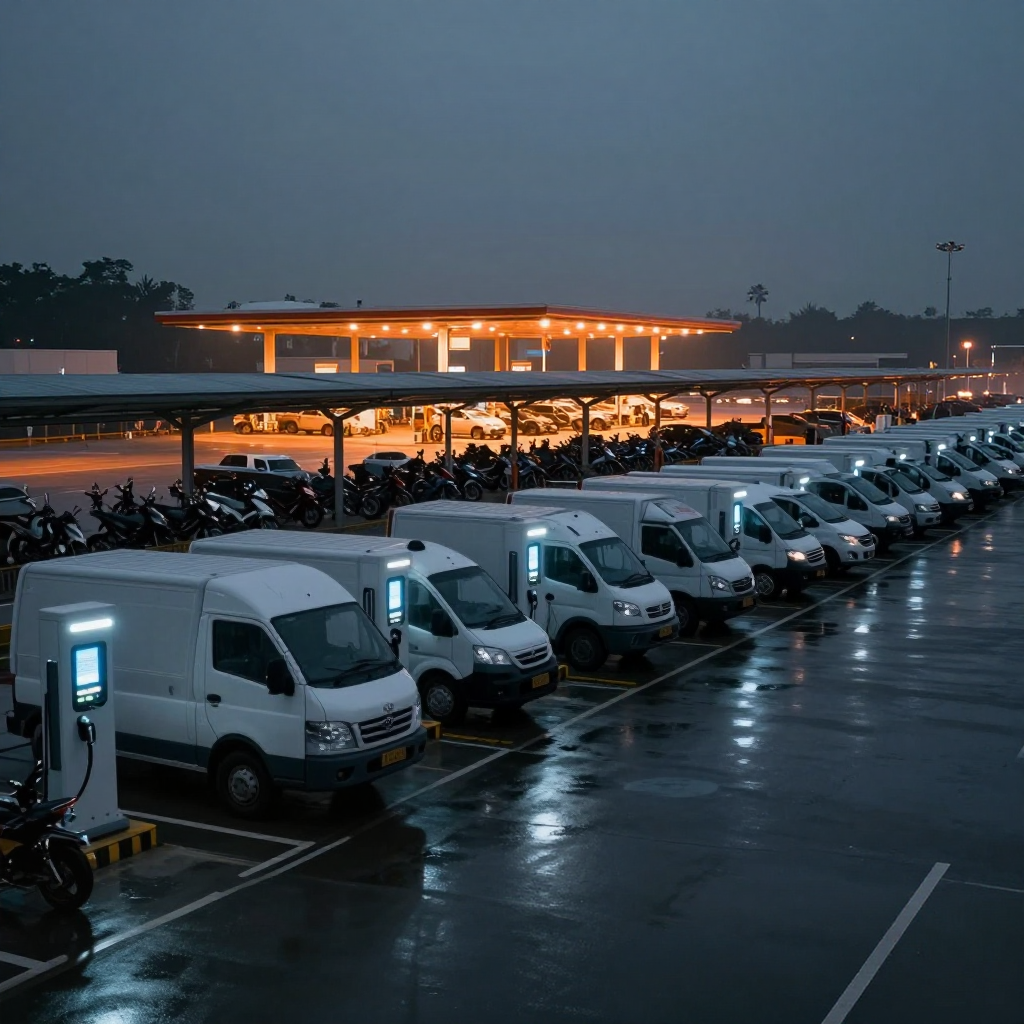
Trap 1: The public-charging trap. The per-km advantage assumes depot-rate electricity. Charge on the public network and the economics halve: Thai public DC retails at 5.5–7.5 THB/kWh against a regulated EV tariff of 2.92; Indonesia's SPKLU ceiling is Rp 2,466 per kWh plus session fees of up to Rp 57,000 for ultra-fast charging. Worse than the price is the time: public chargers are built for private cars, not for twenty vans that all return at 6 p.m. or taxis that must charge inside a 40-minute shift change. One fast charger can serve about ten ride-hail EVs — a fleet of 200 needs dedicated capacity where the fleet actually dwells, or drivers burn paid hours hunting and queuing. The oil-shock queue and the charging queue are the same failure with different fuels.
Trap 2: The DIY-infrastructure trap. The instinctive response — "we'll build our own depot chargers" — collides with three walls at once. Capital: an installed DC fast-charging position runs US$90,000–150,000, and the electrical infrastructure behind it is typically 40–60% of project cost; a serious depot is a seven-figure project. Grid: high-power connections take 12–24 months to secure in most markets, with transformer lead times now stretching past two years globally — you cannot Amazon-Prime a substation. Competence: a logistics company's capital and management attention belong in vehicles, routes, and customers — not in becoming a small, sub-scale power-infrastructure developer.
Trap 3: The vehicle-risk trap. The vehicle side carries its own fine print. Used-EV values in Indonesia have fallen as much as 60%, ex-taxi EVs have traded at near-scrap prices, and Thai research house Krungsri puts first-resale depreciation at ~23% — while financing companies remain reluctant to touch used EVs. Warranty terms matter more than headline years: at least one popular "lifetime" battery warranty in Indonesia is void for commercial use above 30,000 km per year — precisely a fleet's duty cycle. And incentives whiplash: Thailand's EV3.0-to-EV3.5 transition pushed some sticker prices up 33% in a single month, and the 2× tax deduction for electric trucks and buses lapsed in December 2025 with renewal still unconfirmed. Structure, not sentiment, is what protects a fleet from all three.
What the structure looks like
The pattern that works — proven at scale in China, where a million electric trucks now operate and port fleets run "charge 15 minutes, operate 4 hours" duty cycles on megawatt hardware — separates the transition into layers, each held by the party best built to carry it:
- The fleet operator runs vehicles and keeps its capital in the fleet. The vehicle market itself now offers routes that transfer battery and residual risk — manufacturer leasing and battery-subscription schemes are publicly available in both markets — and that choice stays with the operator.
- The infrastructure developer — this is nPower's role, and deliberately its whole role: we are an asset developer in energy infrastructure, not a lender or a leasing house. We fund, permit, build, and own the charging assets, engineered around the fleet's actual duty cycles: depot overnight charging plus high-power top-up hubs at shift-change and route nodes. Because the asset is anchored by contracted fleet demand, it starts life at the 80–90% utilisation that public networks spend years praying for.
- Equipment suppliers — we procure directly from the Chinese manufacturers who lead the world in fast-charging hardware at costs as much as 30–40% below Western equivalents, and who frequently co-invest in the assets that deploy their technology. The supplier's balance sheet and the fleet's energy bill end up on the same side.
- Local partners operate day-to-day, under long-term agreements.
| Fleet does it alone | Layered model (with nPower) | |
|---|---|---|
| Charging capex | US$90–150k per DC position, on fleet balance sheet | Zero — nPower funds, builds, owns |
| Grid & permits | 12–24-month connection risk carried by fleet | Carried by nPower & local partners |
| Energy price | Public retail: 2–3× depot tariff | Contracted depot rates, availability SLA |
| Equipment cost & tech risk | Retail procurement, obsolescence risk | Direct China supply chain; suppliers co-invest |
| Fleet capital goes to | Chargers + vehicles | Revenue-earning vehicles only |
For the fleet owner, the offer reduces to one sentence: convert the fleet without building the infrastructure — zero charging capex, energy at depot rates locked by contract, availability guaranteed around your schedule, and immunity from the next Hormuz.
The window
Sites and grid capacity are the finite inputs. The best depot locations, the substations with spare capacity, the land at the right route nodes in both countries — the race to secure them is under way, in the same months that fuel-price fear is at its peak and dealer networks are switching sides. Operators who move in the next few quarters will lock infrastructure on first-mover terms; those who wait will rent it from whoever didn't.
The queue at the petrol station was the message. The response is not to wait for oil to calm down — it is to make the next oil shock someone else's problem.
nPower develops, finances, and manages EV charging and new-energy infrastructure across Asia and Europe, working with fleet operators, equipment suppliers, and co-investors. If you operate a taxi, ride-hail, or logistics fleet in Indonesia or Thailand and are weighing conversion, we are speaking with operators now about anchor-fleet charging partnerships: contact@npower-ventures.com